Sash Windows.
A very short History:
Where do Sash windows come from?
There is some debate as to whether Sash windows originated in England, France or Holland. It is plausible they originated in France, and were adopted soon afterwards in both Holland and England. There is a lack of definitive evidence to be absolutely certain of their origin.
When were they first used in the UK?
What is known with some certainty is the earliest recorded use of Sash windows in the UK was in the 1670s in Ham House in Richmond,
and Palace House Beaulieu.
Is a window a Sash or Casement?
A Sash window is one in which the opening element (The Sash) slides either horizontally (in the UK referred to as a Yorkshire Sash) or, much more common, vertically.
A Casement window is one in which the opening element (The Casement) is hinged, again either horizontally, or vertically.
Where do the names Sash and Casement come from?
The name Sash is likely derived from:
*“a mangled English-ing of [the] French“châssis” -"frame" of a window or door”.
The name Casement, has similar roots, again in French:
**“...probably a shortening of Old French dialectal“enchassement” - "window frame".”
What are the major Architectural styles?
- Early Stuart / Baroque
- Georgian
- Victorian
- Edwardian
Each period is defined by certain common characteristics, but contains within it many stylistic and functional variations. These are often regional.
*https://www.etymonline.com/word/sash
**https://www.etymonline.com/search?q=casement
A Guide to Dating Sash Windows by Architectural Period
1. Early Stuart / Baroque (c. 1670 – 1714)
This period marks the introduction and early development of the sash window, shortly after the Great Fire of London (1666).
Feature/Description:
Glazing Bar Width: Very thick, often up to 2 inches - approx 50mm wide. This was necessary to hold small, irregular panes of hand-blown glass.
Pane Configuration: Numerous, small panes, commonly 8 over 8 or 12 over 12.
Sash Operation: Earliest forms were single-hung (top sash fixed, bottom slides in a groove). The counterbalanced, double-hung system became common later in the period (c. 1680s).
Sash Horns:Absent.
2. Georgian (1714 – 1837)
Defined by symmetry and classical elegance, the design was refined as glass technology improved.
Feature/Description:
Glazing Bar Width: Progressively slimmer. As glass quality improved, the bars became more slender, reducing from approx 25mm to as narrow as 13 mm
-1/2 inch by the late 18th century.
Pane Configuration: The definitive style is 6 over 6 (six panes in the top sash, six in the bottom). 8 over 8 was also common in earlier buildings.
Glazing Profile: Glazing bars were often given delicate profiles, such as the ovolo or astragal and hollow.
Sash HornsAbsent: The thin timber bars and small panes did not require external reinforcement.
3. Victorian (1837 – 1901)
The Industrial Revolution brought mass-produced, cheaper, and larger sheets of glass, leading to radical changes in window aesthetics.
Feature/Description:
Glazing Bar Width: Became much slimmer or absent entirely as large panes reduced the need for multiple divisions.
Pane Configuration: Shifted to fewer, larger panes. The most common configuration became 2over2, and by the late era, 1over1 was frequently used.
Sash Horns: Present. These decorative and structural projections (short downward projections at the bottom of the top sash) were introduced to strengthen the frame against the weight of the new, larger panes.
Decoration:
Often more decorative than Georgian, sometimes incorporating coloured or stained glass.
4. Edwardian (1901 – 1914)
The style marked a return to the elegance of the Georgian era, combined with the technological advantages of Victorian glass.
Feature/Description:
Glazing Bar Width: Varied, but the bars in the upper sash are slender.
Pane Configuration: A distinctive 6 over 1 or 6 over 2 configuration became typical: a multi-pane 6 pane upper sash over a large 1 pane (or 2 pane) lower sash.
Sash HornsPresent: Carried over from the Victorian period.
Architecture: Windows are often wider and taller than their Victorian counterparts to maximize light.
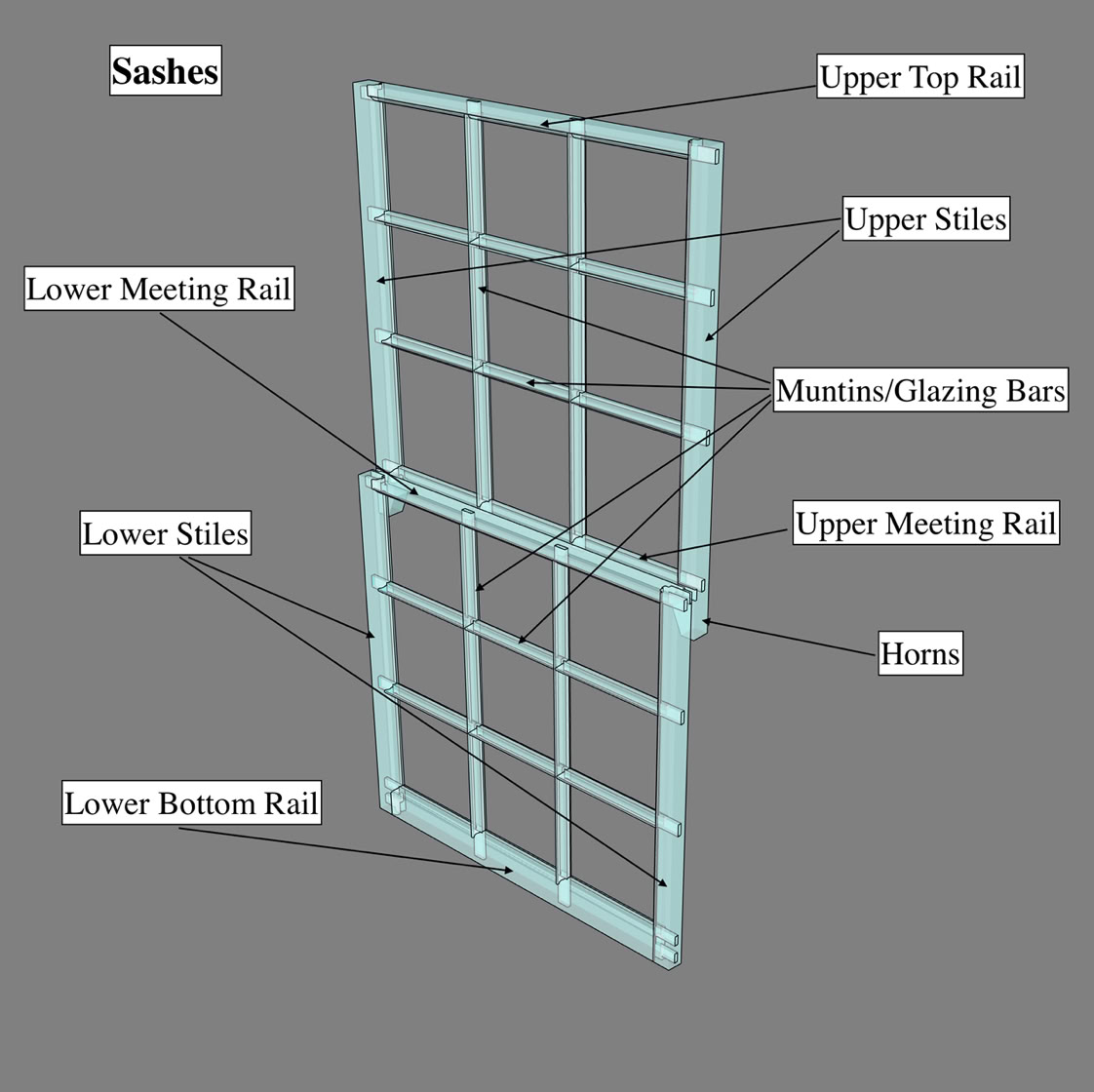
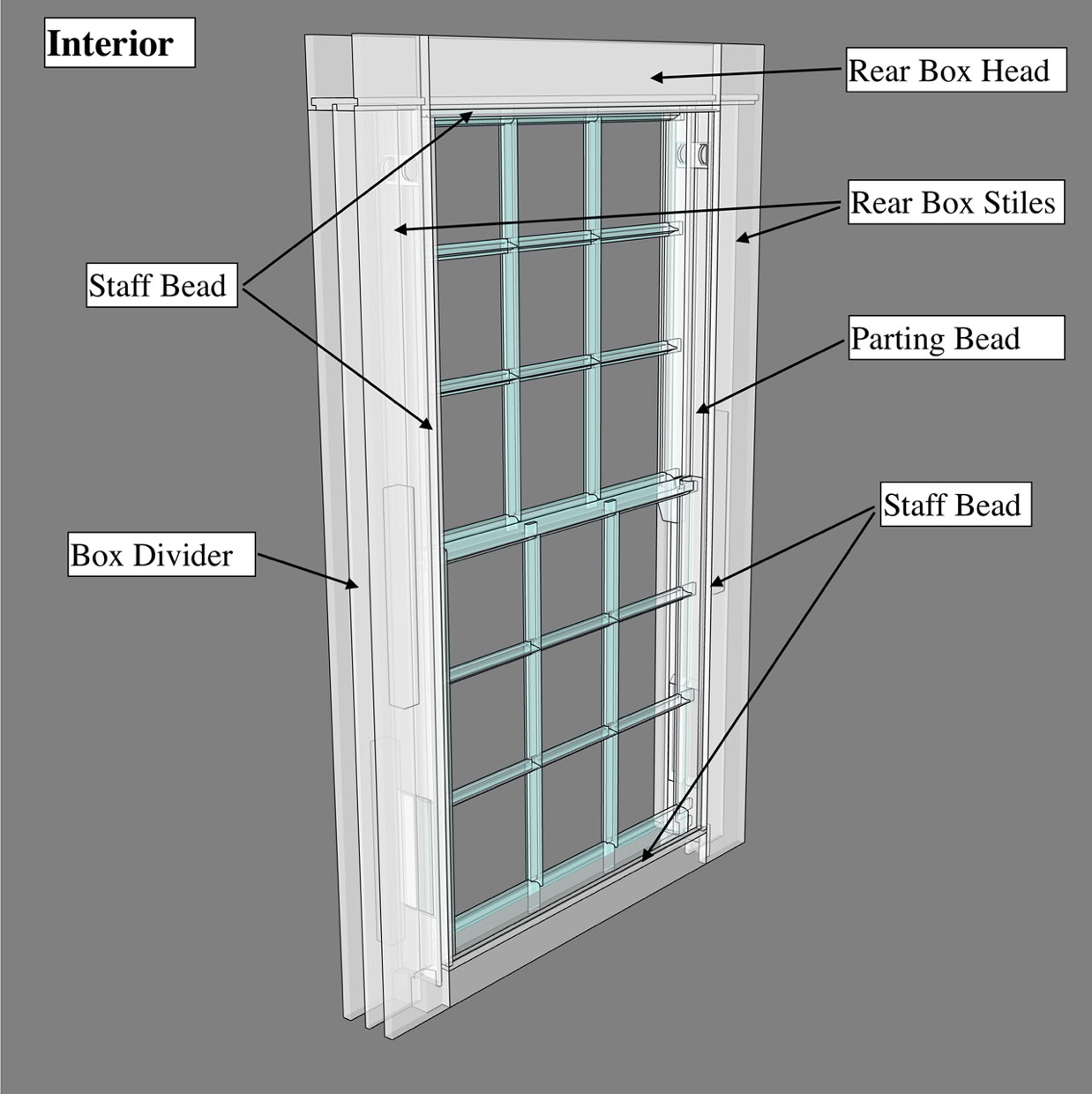
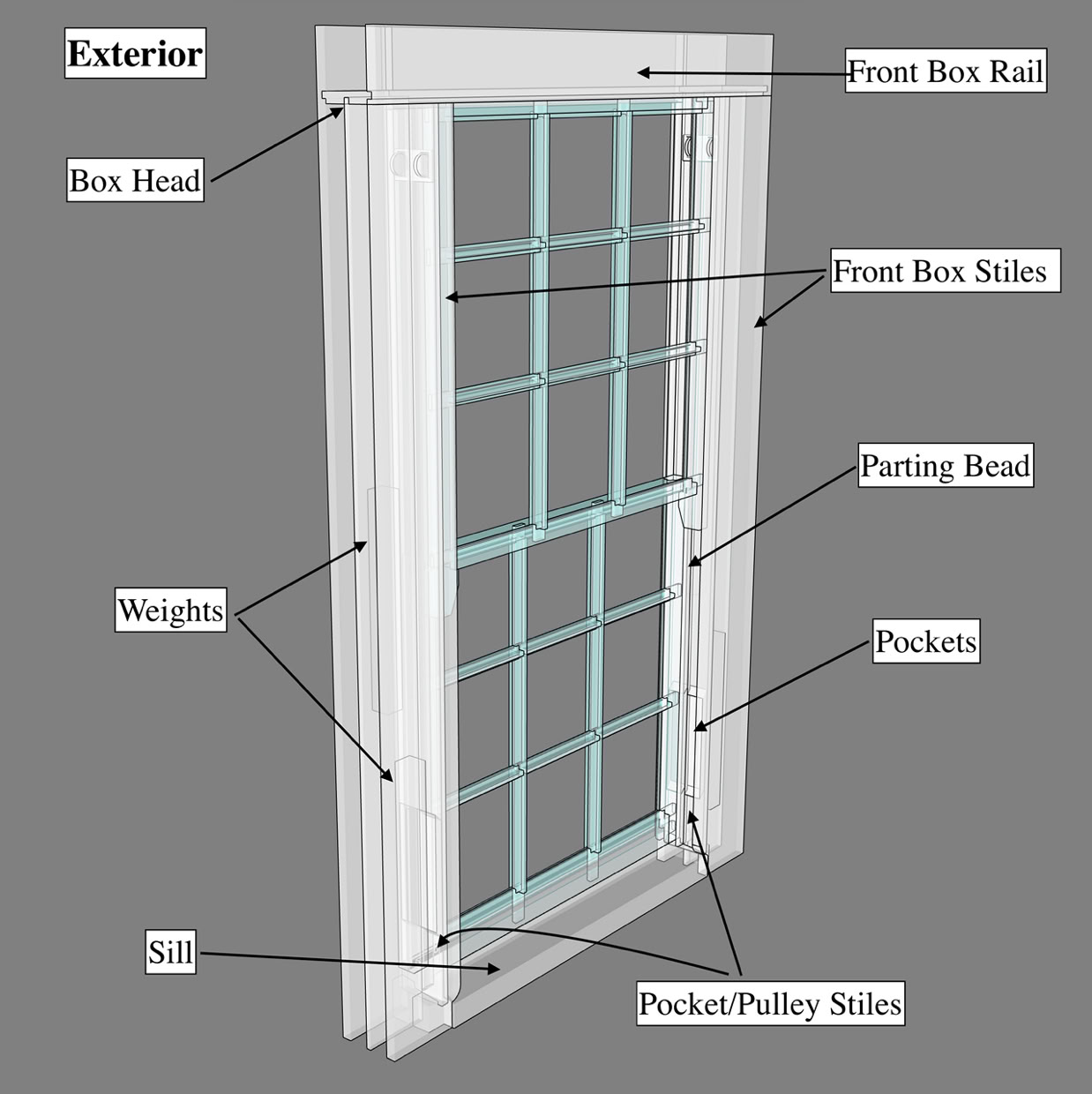
Sash Window Anatomy